
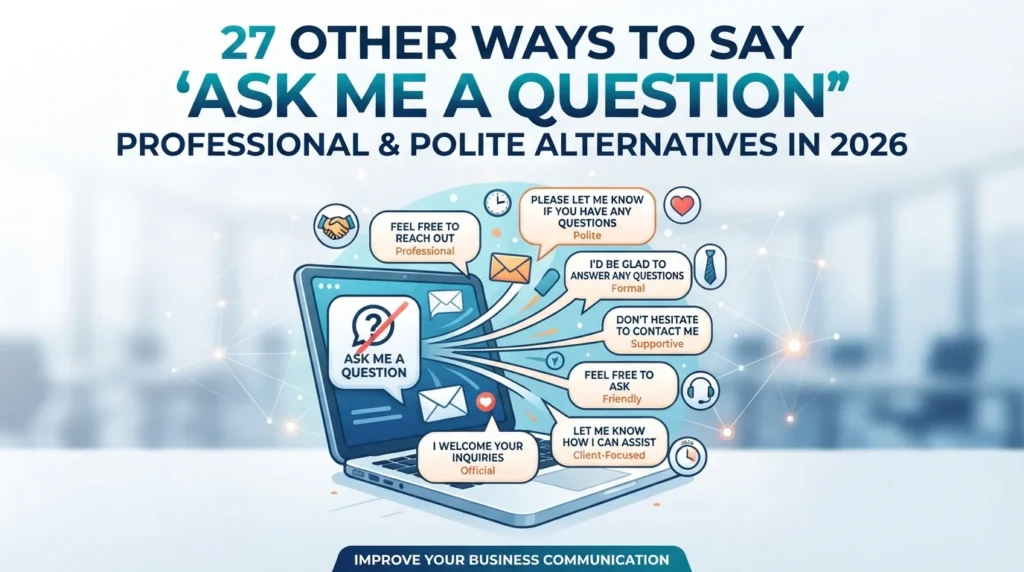
Finding other ways to say “ask me a question” can make your communication sound more professional, polished, and engaging. While the phrase itself is clear and friendly, repeating it in emails, workplace conversations, meetings, and customer interactions can feel repetitive.
Many professionals search for a professional way to say ask me a question, a formal alternative to ask me a question, or a suitable synonym for ask me a question when writing business emails or communicating with clients.
The right alternative depends on your audience and situation. A phrase that works well in a casual team chat may sound too informal in a client email. Likewise, an overly formal expression can create distance in a friendly conversation.
This guide covers professional, formal, friendly, workplace, and email-ready alternatives, complete with examples and practical usage tips.
What Does “Ask Me a Question” Mean?
Literal Meaning
“Ask me a question” is an invitation for someone to seek information, clarification, advice, or feedback from you.
Tone
The phrase is generally:
- Friendly
- Open
- Welcoming
- Conversational
Purpose
People use it to:
- Encourage communication
- Invite discussion
- Offer help
- Create engagement
- Build trust
Emotional Context
The phrase often communicates:
- Availability
- Approachability
- Willingness to help
- Confidence in sharing information
Examples
- “If you need assistance, ask me a question.”
- “Feel free to ask me a question about the project.”
- “Ask me a question anytime during the presentation.”
When Is It Appropriate to Use?
Emails
Useful when inviting follow-up communication.
Example:
If you need additional details, please ask me a question at any time.
Workplace Communication
Helps encourage collaboration and knowledge sharing.
Example:
If anything is unclear, ask me a question before proceeding.
Client Communication
Shows availability and support.
Example:
Please ask me a question if you’d like clarification regarding the proposal.
Networking
Encourages meaningful conversation.
Example:
Feel free to ask me a question about my experience in the industry.
Customer Service
Builds trust and confidence.
Example:
Ask me a question if you need help choosing the right option.
27 Professional Alternatives to “Ask Me a Question”
Professional Alternatives
1. Feel Free to Reach Out
Tone: Professional, approachable
Best Use: Emails and workplace communication
Example:
Feel free to reach out if you need further clarification.
2. Please Let Me Know If You Have Any Questions
Tone: Professional
Best Use: Business emails
Example:
Please let me know if you have any questions regarding the proposal.
3. I’m Happy to Help
Tone: Warm and professional
Best Use: Client communication
Example:
I’m happy to help if anything needs clarification.
4. Don’t Hesitate to Contact Me
Tone: Professional and supportive
Best Use: Customer service
Example:
Don’t hesitate to contact me if you need assistance.
5. I’d Be Glad to Answer Any Questions
Tone: Professional
Best Use: Formal correspondence
Example:
I’d be glad to answer any questions about the process.
Formal Alternatives
6. Please Inquire Further If Needed
Tone: Formal
Best Use: Official communication
Example:
Please inquire further if additional information is required.
7. Kindly Direct Any Questions to Me
Tone: Formal
Best Use: Corporate communication
Example:
Kindly direct any questions to me before Friday.
8. I Welcome Your Inquiries
Tone: Formal
Best Use: Business presentations
Example:
I welcome your inquiries regarding this matter.
9. Please Seek Clarification If Necessary
Tone: Formal
Best Use: Policies and procedures
Example:
Please seek clarification if any aspect remains unclear.
10. I Remain Available for Questions
Tone: Formal
Best Use: Executive communication
Example:
I remain available for questions concerning the report.
Friendly Alternatives
11. Feel Free to Ask
Tone: Casual and friendly
Best Use: Team communication
Example:
Feel free to ask if something doesn’t make sense.
12. Let Me Know What’s on Your Mind
Tone: Friendly
Best Use: Informal discussions
Example:
Let me know what’s on your mind.
13. I’d Love to Hear Your Questions
Tone: Warm
Best Use: Workshops
Example:
I’d love to hear your questions after the presentation.
14. Fire Away
Tone: Casual
Best Use: Informal meetings
Example:
Fire away if you have questions.
15. Ask Away
Tone: Very friendly
Best Use: Conversations and forums
Example:
Ask away—I’m happy to help.
Email-Friendly Alternatives
16. Please Feel Free to Contact Me
Tone: Professional
Best Use: Email sign-offs
Example:
Please feel free to contact me with any concerns.
17. Let Me Know How I Can Assist
Tone: Professional
Best Use: Client emails
Example:
Let me know how I can assist further.
18. Reach Out If You Need Anything
Tone: Friendly professional
Best Use: Internal communication
Example:
Reach out if you need anything.
19. I’m Available to Discuss Further
Tone: Professional
Best Use: Follow-up emails
Example:
I’m available to discuss further at your convenience.
20. Please Share Any Questions You May Have
Tone: Formal professional
Best Use: Client communication
Example:
Please share any questions you may have.
Workplace Alternatives
21. Let Me Clarify Anything That’s Unclear
Tone: Collaborative
Best Use: Team meetings
Example:
Let me clarify anything that’s unclear.
22. Bring Any Questions to Me
Tone: Direct
Best Use: Team leadership
Example:
Bring any questions to me before implementation.
23. I’m Here as a Resource
Tone: Supportive
Best Use: Leadership communication
Example:
I’m here as a resource if you need guidance.
24. Please Raise Any Questions
Tone: Professional
Best Use: Meetings
Example:
Please raise any questions before we conclude.
25. Let Me Know If Anything Needs Clarification
Tone: Professional
Best Use: Project communication
Example:
Let me know if anything needs clarification.
26. I’m Open to Questions
Tone: Professional and approachable
Best Use: Presentations
Example:
I’m open to questions at any point.
27. Please Feel Free to Ask for More Information
Tone: Professional
Best Use: Client and workplace communication
Example:
Please feel free to ask for more information if needed.
Quick Comparison Table
| Alternative | Tone | Best Use |
|---|---|---|
| Feel free to reach out | Professional | |
| Let me know if you have questions | Professional | Clients |
| I’m happy to help | Friendly Professional | Customer service |
| Don’t hesitate to contact me | Professional | Business communication |
| I welcome your inquiries | Formal | Corporate settings |
| Feel free to ask | Casual | Team communication |
| Ask away | Friendly | Informal discussions |
| Reach out if you need anything | Professional | Workplace |
| Please raise any questions | Professional | Meetings |
| I’m open to questions | Professional | Presentations |
Email Examples
Client Email
Please let me know if you have any questions regarding the proposal. I’ll be happy to provide additional details.
Manager Email
Please feel free to reach out if you require clarification on any aspect of the report.
Colleague Email
Let me know if anything needs clarification before the meeting.
Customer Email
Don’t hesitate to contact me if you need assistance selecting the best option.
Networking Email
I’d be glad to answer any questions about my background and experience.
Meeting Follow-Up Email
Please raise any additional questions that may come up after reviewing the meeting notes.
Common Mistakes
1. Overusing the Same Phrase
Repeating “ask me a question” in every email can sound robotic.
Use varied business email phrases instead.
2. Using Casual Language in Formal Situations
“Ask away” may sound inappropriate in executive communications.
Choose formal alternatives when needed.
3. Being Excessively Formal
“I welcome your inquiries” may feel stiff in team chats.
Match the tone to the audience.
4. Forgetting Email Etiquette
Always keep invitations for questions concise and clear.
Avoid lengthy explanations that bury the main message.
Related Phrases and Expressions
| Phrase | Meaning | Example |
|---|---|---|
| Reach out to me | Contact me | Reach out to me anytime. |
| Let me know | Inform me | Let me know if you need help. |
| Contact me | Get in touch | Contact me with concerns. |
| Seek clarification | Request explanation | Seek clarification when needed. |
| Share your thoughts | Express opinions | Share your thoughts on the proposal. |
| Raise a concern | Mention an issue | Raise a concern if necessary. |
| Request information | Ask for details | Request information anytime. |
| Get in touch | Communicate | Get in touch for updates. |
| Inquire further | Ask additional questions | Inquire further if required. |
| Ask for guidance | Seek advice | Ask for guidance anytime. |
| Follow up | Continue discussion | Follow up after review. |
| Request support | Seek assistance | Request support if needed. |
| Provide feedback | Share opinions | Provide feedback after testing. |
| Share questions | Express inquiries | Share questions during the meeting. |
| Request clarification | Ask for explanation | Request clarification if confused. |
Phrase Comparison
| Phrase | Formality | Tone | Best Use |
|---|---|---|---|
| Ask me a question | Neutral | Friendly | General communication |
| Feel free to ask | Casual | Friendly | Team chats |
| Please let me know if you have questions | Professional | Polite | |
| I welcome your inquiries | Formal | Professional | Corporate |
| Ask away | Informal | Relaxed | Casual discussions |
| Don’t hesitate to contact me | Professional | Supportive | Clients |
| Kindly direct any questions to me | Formal | Respectful | Executive communication |
Cultural Usage
US English
Americans commonly use:
- Feel free to ask
- Reach out
- Let me know
These sound natural and approachable.
UK English
British professionals often prefer:
- Please let me know if you have any questions
- Do not hesitate to contact me
- Kindly direct any questions to me
These expressions sound polite and professional.
Corporate Communication
The most common choices are:
- Please let me know if you have any questions
- Feel free to reach out
- I’m available to discuss further
Customer Service
Common options include:
- I’m happy to help
- Don’t hesitate to contact me
- Please share any questions you may have
Networking
Popular phrases include:
- I’d be glad to answer any questions
- Feel free to reach out
- Let me know what’s on your mind
Frequently Asked Questions
1. What is a professional way to say “ask me a question”?
“Please let me know if you have any questions” is one of the most professional options for business communication.
2. What is the best formal alternative to “ask me a question”?
“I welcome your inquiries” and “Kindly direct any questions to me” are strong formal alternatives.
3. Is “feel free to ask” professional?
Yes. It is professional in most workplace and team communication settings.
4. What should I say in a business email instead?
Use “Please let me know if you have any questions” or “Feel free to reach out.”
5. What is the most polite option?
“Don’t hesitate to contact me” is widely considered polite and professional.
6. Can I use “ask away” at work?
Yes, but mainly in casual workplace environments and team discussions.
7. Which phrase works best with clients?
“Please share any questions you may have” works well with clients.
8. What phrase sounds most approachable?
“I’m happy to help” creates a welcoming and approachable tone.
9. What is a good customer service alternative?
“Don’t hesitate to contact me if you need assistance” is highly effective.
10. Which alternative is best for networking?
“Feel free to reach out” is one of the best networking phrases because it encourages future communication.
Conclusion
Choosing the right alternative to “ask me a question” can improve your professional communication, strengthen workplace relationships, and create a more polished impression in emails and business conversations. While the original phrase is clear and friendly, using varied expressions helps match the tone of different situations. For professional emails, phrases like “Please let me know if you have any questions” and “Feel free to reach out” work exceptionally well. In formal settings, options such as “I welcome your inquiries” or “Kindly direct any questions to me” sound more refined. For casual conversations, “Feel free to ask” and “Ask away” keep communication open and approachable. Selecting the right phrase ensures better email etiquette, stronger workplace communication, and more effective professional interactions.