Quick Answer
Scrap and scrape look almost identical, but they mean different things. Use scrap when you talk about a small piece of something, waste material, or the act of throwing something away. Use scrape when you talk about rubbing something hard against a surface, scratching or injuring skin, or barely managing to do something. One simple way to keep them straight: a scrap is a thing you can hold (a scrap of paper), while to scrape is an action your body does (you scrape your knee). If you ever need to explain a tricky word in plainer language, these other ways to say means give you extra wording options.
What Does “Scrap” Mean?
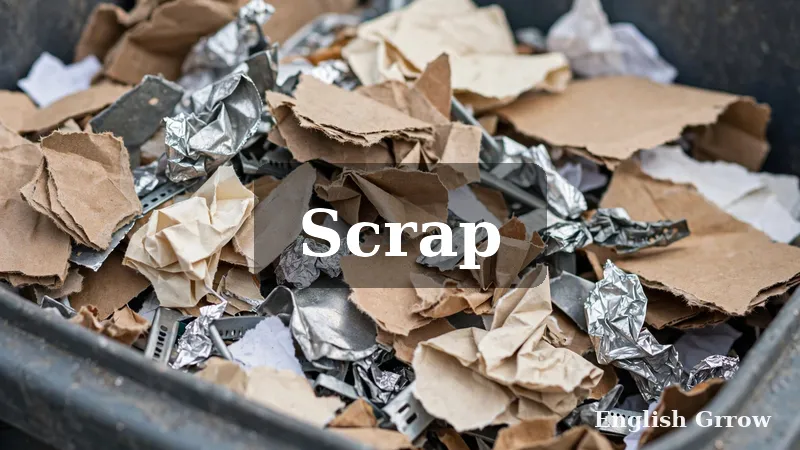
Scrap works as both a noun and a verb, and all its meanings connect to the idea of pieces and leftovers.
As a noun, scrap has three common meanings:
- A small piece of something: “She wrote the number on a scrap of paper.” You use it when only a bit of something remains.
- Waste or leftover material: “They sold the old car for scrap metal.” Here it means material that is no longer useful in its current form but can be recycled.
- An informal fight or quarrel: “The two boys got into a scrap at recess.” This meaning is casual and mostly heard in British English.
As a verb, scrap (scrapped, scrapping) means to throw away or give up on something: “The company scrapped the old design.” If you scrap a plan, you abandon it completely.
More examples:
- He picked up a scrap of cloth from the floor.
- The factory recycles scrap plastic into new bottles.
- We decided to scrap the trip because of the storm.
What Does “Scrape” Mean?
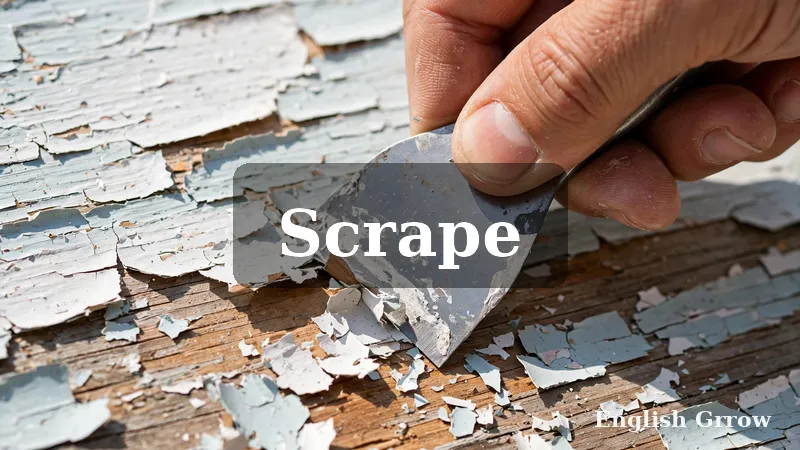
Scrape is mainly a verb, and its core idea is rubbing or scratching against a surface. It also works as a noun in two useful phrases.
As a verb, scrape (scraped, scraping) means:
- To rub something hard against a surface: “She scraped the mud off her boots.” Think of a harsh, rough rubbing motion.
- To scratch or injure skin by rubbing: “He scraped his knee when he fell off the bike.” The injury comes from contact with a rough surface.
- To barely manage or succeed with difficulty: “She scraped through the exam with the lowest passing grade.” Here it paints a picture of just squeezing past.
As a noun, scrape has two meanings:
- A mark or injury from rubbing: “There is a scrape on the car door.”
- An awkward or difficult situation: “He got into a scrape with the law.” This is informal and means trouble.
More examples:
- Do not scrape the chair across the floor.
- The cat tried to scrape its way out of the box.
- They scraped together enough money for the tickets.
Scrap vs Scrape: Key Differences
When you introduce examples in your writing, you will often write “for instance.” If you want variety, here are other ways to say for instance you can use instead. Now look at the side-by-side comparison:
| Point | Scrap | Scrape |
|---|---|---|
| Core idea | A piece or leftover; to discard | To rub or scratch; a rubbing mark |
| Typical use | A scrap of paper; scrap metal | Scrape the paint; scraped his knee |
| Verb sense | To throw away: “scrap the plan” | To rub hard: “scrape the pan” |
| Past tense | Scrapped (double p) | Scraped |
| Useful phrase | “Sell it for scrap” | “Scrape through the exam” |
| Informal noun use | A small fight: “a scrap” | Trouble: “get into a scrape” |
Correct Usage Rules
- If you can replace the word with “piece” or “throw away,” use scrap. “A scrap of paper” means a piece of paper. “Scrap the idea” means throw the idea away.
- If you can replace the word with “rub,” “scratch,” or “barely manage,” use scrape. “Scrape the ice off the windshield.” “He scraped by with a pass.”
- Remember the noun forms. A scrap is a thing you can touch. A scrape is a mark, an injury, or a difficult situation.
- Watch the spelling of the past tense. The past tense of scrap is scrapped with a double p: “They scrapped the project.” The past tense of scrape is scraped: “She scraped her elbow.”
- In formal writing, avoid the informal fight meaning. Use “disagreement” or “conflict” instead of “a scrap” in essays and reports. When you list examples in formal writing, you can also explore other ways to say such as to vary your phrasing.
Example Sentences Using Scrap and Scrape
Read these pairs out loud and notice how one missing letter changes the meaning. Writers who vary their dialogue also look for other ways to say said to keep their writing fresh, and the same habit of careful word choice helps here.
- She saved every scrap of ribbon from the gift.
- He scraped the burnt toast with a knife.
- The school decided to scrap the old uniform policy.
- Be careful not to scrape your car on the gate.
- There was not a scrap of evidence against him.
- The toddler scraped his chin on the pavement.
- They collect scrap metal to sell at the market.
- She managed to scrape together enough coins for the bus.
- Do not scrap a good idea just because it is new.
- He scraped through the interview and got the job.
- The puppy chewed the newspaper into scraps.
- A scrape on her arm reminded her of the fall.
Common Mistakes to Avoid
- Writing “scrap” when you mean the rubbing action. Wrong: “He scrap the mud off his boots.” Right: “He scraped the mud off his boots.” People sometimes drop the middle E sound, so double check the spelling.
- Mixing up the past tenses. “Scrapped” with a double p belongs to scrap, and “scraped” belongs to scrape. “They scraped the plan” is wrong when you mean they abandoned it. The right sentence is “They scrapped the plan.”
- Using the informal “scrap” for a fight in essays. “The nations got into a scrap” sounds too casual for formal writing. Use “conflict” or “dispute” instead.
- Guessing instead of checking. When you are unsure which word fits, do not just pick one and hope. Admit the gap and look it up, or use these other ways to say I don’t know to ask for help politely.
A Simple Memory Trick
Think of the letter E in scrapE. The E stands for “erase,” which is a rubbing action. When you erase, you scrape the eraser across the paper. So scrape with an E means a rubbing action. Scrap has no E, and it means a piece or the act of throwing away. Picture a tiny piece of paper: small, with no extra letter and no extra action. If you see the extra E in the middle of the word, think of the extra rubbing motion.
Another quick check: say your sentence out loud. If “rub” or “scratch” fits in the blank, you need the E: scrape. If “piece” or “throw away” fits, drop the E: scrap.
FAQs About Scrap and Scrape
1. Is it “scrap of paper” or “scrape of paper”?
It is scrap of paper. You mean a small piece of paper, so use scrap without the E.
2. What is the past tense of scrap?
The past tense is scrapped with a double p: “They scrapped the old rules.”
3. What is the past tense of scrape?
The past tense is scraped: “She scraped her knee on the steps.”
4. Can scrape be a noun?
Yes. A scrape can mean a rubbing injury (“a scrape on his arm”) or an awkward situation (“got into a scrape”).
5. What does “scrap metal” mean?
It means waste metal that can be recycled or sold, like old car parts and cans.
6. What does “scrape through” mean?
It means to pass or succeed only just, with difficulty: “He scraped through the final exam.”
7. Which one should I use in formal writing?
Both words are fine in formal writing with their standard meanings. Just avoid the informal “a scrap” for a fight. If you want to express a belief politely in a formal email, these other ways to say I believe can help.
8. Are scrap and scrape pronounced the same?
Almost. Scrap is pronounced with a short “a” as in “cat,” and scrape is pronounced with a long “a” as in “ape.” The vowel sound is the audible difference.
Final Summary
Scrap: a small piece, waste material, or the act of throwing something away. Scrape: the act of rubbing or scratching, a rubbing injury, or barely succeeding. Keep the E trick in mind: scrape = an erase-like rubbing action. When you write to a teacher or colleague asking for guidance on word choice, these other ways to say please advise can make your request sound more polished. For the full dictionary definition with pronunciation audio, see the Cambridge Dictionary entry for scrape.